

How To Repair Boat Gel Coat
Gelcoat Scratch Repair
Surface scratches tin can be buffed out of gelcoat with polishing compound, but deep scratches must exist filled. When the gelcoat surrounding a scratch is in good status, the filler of pick is gelcoat paste, which provides both filler and terminate in a single application — but not a unmarried step. Considering the surface of the cured paste will be uneven, sanding and polishing are required to smooth the repair and blend it with the rest of the hull. Except for color matching, gelcoat repairs are easy and straightforward.
Gelcoat Choices
You lot volition find gelcoat available as both a resin and in a thicker putty form called paste. For scratch repair you lot want paste. Repair kits comprised of a small amount of gelcoat paste and hardener, a option of pigments, mixing sticks, and sealing film tin can exist purchased for less than $twenty. Buy a flexible plastic spreader if you don't already have one. Y'all will also demand sheets of 150-, 220-, 400-, and 600-grit wet-or-dry sandpaper. A single sheet of each will be more ample to off-white all the paste in a repair kit.
Color Matching
The hardest part of a repair to the surface of a fiberglass boat is matching the colour. Professionals who do gelcoat repairs daily still have difficulty getting a perfect match. Even "manufacturing plant" colors don't match exactly afterward a gunkhole has been in the dominicus for a few years.
White has the significant reward of existence fairly easy to friction match, and in one case a minor repair is buffed out to a gloss, shading differences volition be unnoticeable. Matching colored hulls is somewhat more challenging.
A color-sample bill of fare from your local paint store that matches your hull can provide valuable help. Inquire the store clerk the formula; they custom-mix the color by adding tints to a white base. The formula may call for a half-dozen different tints, merely the important ones are those specified in the largest quantities. You lot can use the tints in your repair kit to estimate the formula.
Always color gelcoat paste before you add together the goad. Put exactly ane ounce of paste into a mixing loving cup and add the tints a drop at a fourth dimension. Keep track of the number of drops of each tint. When the colour looks close in the loving cup, touch a drop of the mix onto the hull. Make needed adjustments until you are satisfied with the lucifer — don't expect perfection — then write downwards the formula then you lot can duplicate it for the residuum of the paste.
Preparing the Scratch
Never endeavor to repair a scratch by merely painting over information technology with gelcoat. Gelcoat resin is too thin to make full a scratch and gelcoat paste is besides thick. Instead of penetrating scratches, gelcoat paste will bridge them, leaving a void in the repair. To get a permanent repair, draw the corner of a scraper or screwdriver down the scratch to open it into a wide V.
Catalyzing
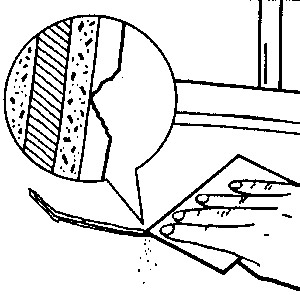
Catalyzing Polyester Resin
The hardener for gelcoat is the aforementioned as for any polyester resin — methyl ethyl ketone peroxide, or MEKP. Gelcoat resin unremarkably requires 1 to 2 percent of hardener by volume (follow the manufacturer's instructions). As a general rule, 4 drops of hardener volition catalyze 1 ounce of resin at 1 percentage. The mix shouldn't kick (start to harden) in less than 30 minutes. Hardening in nigh two hours is probably platonic. Always err on the side of too little hardener. Also be certain to stir in the hardener thoroughly; if you lot neglect to catalyze every bit of the resin, parts of the repair will be undercured.
Spreading Gelcoat Paste
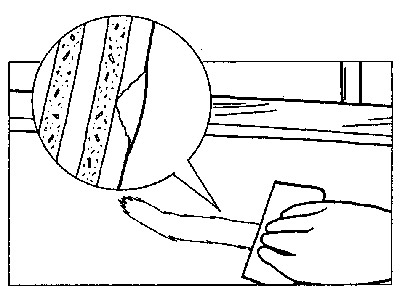
Spreading Gelcoat Paste
Work the gelcoat paste into the scratch with a flexible plastic spreader. Allow the putty bulge a little behind the spreader; polyester resin shrinks slightly as it cures, and y'all're going to sand the patch anyway. But don't let information technology bulge too much or you'll make extra work for yourself.
Scrape up any excess paste beyond the patch surface area.
Covering the Repair
Gelcoat will not fully cure in air. To seal the surface of a scratch repair, cover it with a sail of plastic moving-picture show. The kit may include sealing picture. Otherwise a section of kitchen "zipper" purse works especially well because it tends to remain smoothen and the gelcoat will not adhere to information technology. Tape one edge of the plastic to the surface just beyond the repair, then smooth the plastic onto the gelcoat and tape downwards the remaining sides.
Sanding and Polishing
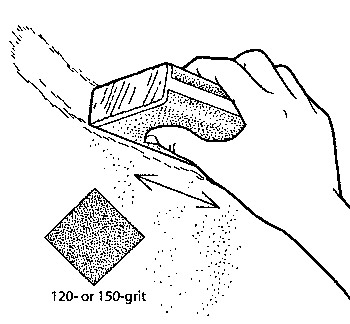
Sanding and Polishing
Later 24 hours, skin away the plastic. The amount of sanding required will depend on how smoothly you applied the gelcoat.
A five 1/2-inch length of ane x 2 makes a convenient sanding block for a scratch repair. Wrap the block with a quarter sheet of 150-dust newspaper. Use the edge of the block to confine your sanding to the new gelcoat. Use short strokes, taking care that the paper is sanding only the patch and not the surrounding surface. Never do this initial sanding without a block backing the paper.
When the new gelcoat is flush, put 220-grit wet-or-dry paper on your block and wet sand the repair, this time with your cake flat. Use a circular movement and go on a trickle of water running on the sanding area. Plume the repair into the quondam gelcoat until your fingertips cannot detect a ridge. If the hull is curved, take care not to sand the repair flat.
Abandon the block and switch to 400-grit wet-or-dry newspaper. Wet sand the surface until the repair surface area has a uniform appearance. Follow this with 600-grit wet-or dry. Wear cloth garden gloves — the kind with the hard dots — to relieve the tips of your fingers.
Dry the area and use rubbing compound to give the gelcoat a loftier gloss. Swirl a soft, folded cloth over the surface of the chemical compound to load the cloth, then rub the compound onto the repair surface area. Buff it with a circular motion, using heavy force per unit area initially, then progressively reduce the pressure until the surface becomes glassy. If the gelcoat shows swirl marks, buff them out with a very fine finishing compound.
Stop the job by giving the repair area a fresh coat of wax. If your color match is reasonably adept, the repair will exist virtually undetectable.
Author
Don Casey
Contributor, BoatUS Mag
Don Casey has been i of the most consulted experts on boat care and upgrades for xxx years, and is ane of the BoatUS Magazine'southward panel of experts. He and his married woman cruise aboard their 30-footer part of the yr in the eastern Caribbean. His books include Don Casey's Consummate Illustrated Sailboat Maintenance Manual, and the recently updated This One-time Boat, the bible for practice-information technology-yourself boaters.
BoatUS Magazine Is A Benefit Of BoatUS Membership
Membership Benefits Include:
-
Subscription to the impress version of BoatUS Magazine
-
4% dorsum on purchases from Due west Marine stores or online at WestMarine.com
-
Discounts on fuel, transient slips, repairs and more than at over 1,200 businesses
-
Deals on cruises, charters, car rentals, hotel stays and more…
-
All for only $25/yr!

How To Repair Boat Gel Coat,
Source: https://www.boatus.com/expert-advice/expert-advice-archive/2012/july/gelcoat-scratch-repair
Posted by: jimenezdidliverse.blogspot.com
0 Response to "How To Repair Boat Gel Coat"
Post a Comment